what stimulates a skeletal muscle cell to contract
Learning Outcomes
- Identify the role of the encephalon in muscle movement
Excitation–Contraction Coupling
Excitation–contraction coupling is the link (transduction) betwixt the activeness potential generated in the sarcolemma and the starting time of a muscle contraction. The trigger for calcium release from the sarcoplasmic reticulum into the sarcoplasm is a neural indicate. Each skeletal muscle fiber is controlled by a motor neuron, which conducts signals from the encephalon or spinal cord to the muscle. The expanse of the sarcolemma on the muscle fiber that interacts with the neuron is chosen themotor end plate. The end of the neuron'due south axon is called the synaptic terminal, and it does not actually contact the motor end plate. A small infinite called the synaptic scissure separates the synaptic terminal from the motor end plate. Electrical signals travel along the neuron'southward axon, which branches through the musculus and connects to individual muscle fibers at a neuromuscular junction.
The power of cells to communicate electrically requires that the cells expend energy to create an electrical gradient across their cell membranes. This accuse gradient is carried past ions, which are differentially distributed across the membrane. Each ion exerts an electrical influence and a concentration influence. Just every bit milk will eventually mix with coffee without the need to stir, ions also distribute themselves evenly, if they are permitted to practice so. In this example, they are not permitted to return to an evenly mixed country.
The sodium–potassium ATPase uses cellular energy to move K+ ions inside the cell and Na+ ions outside. This alone accumulates a small electrical accuse, but a big concentration slope. At that place is lots of K+ in the jail cell and lots of Na+ outside the jail cell. Potassium is able to leave the cell through Grand+ channels that are open up 90% of the time, and it does. However, Na+ channels are rarely open, so Na+ remains outside the prison cell. When Chiliad+ leaves the prison cell, obeying its concentration slope, that finer leaves a negative accuse behind. And so at rest, there is a large concentration gradient for Na+ to enter the cell, and in that location is an accumulation of negative charges left behind in the cell. This is the resting membrane potential. Potential in this context means a separation of electrical charge that is capable of doing work. It is measured in volts, just like a battery. Nonetheless, the transmembrane potential is considerably smaller (0.07 V); therefore, the minor value is expressed equally millivolts (mV) or 70 mV. Because the inside of a cell is negative compared with the outside, a minus sign signifies the excess of negative charges inside the jail cell, −70 mV.
If an event changes the permeability of the membrane to Na+ ions, they volition enter the cell. That volition modify the voltage. This is an electrical event, called an action potential, that can be used as a cellular bespeak. Advice occurs between fretfulness and muscles through neurotransmitters. Neuron action potentials cause the release of neurotransmitters from the synaptic final into the synaptic cleft, where they can and so diffuse across the synaptic fissure and bind to a receptor molecule on the motor end plate. The motor terminate plate possesses junctional folds—folds in the sarcolemma that create a large surface area for the neurotransmitter to bind to receptors. The receptors are actually sodium channels that open up to let the passage of Na+ into the cell when they receive a neurotransmitter signal.
Acetylcholine (ACh) is a neurotransmitter released by motor neurons that binds to receptors in the motor terminate plate. Neurotransmitter release occurs when an action potential travels down the motor neuron'south axon, resulting in contradistinct permeability of the synaptic terminal membrane and an influx of calcium. The Ca2+ ions allow synaptic vesicles to move to and bind with the presynaptic membrane (on the neuron), and release neurotransmitter from the vesicles into the synaptic cleft. Once released by the synaptic terminal, ACh diffuses across the synaptic crack to the motor end plate, where it binds with ACh receptors. Equally a neurotransmitter binds, these ion channels open, and Na+ ions cross the membrane into the musculus cell. This reduces the voltage divergence between the within and exterior of the cell, which is chosen depolarization. Every bit ACh binds at the motor terminate plate, this depolarization is called an finish-plate potential. The depolarization then spreads along the sarcolemma, creating an activity potential equally sodium channels side by side to the initial depolarization site sense the alter in voltage and open. The activity potential moves across the entire cell, creating a wave of depolarization.
ACh is broken down by the enzymeacetylcholinesterase (Anguish) into acetyl and choline. AChE resides in the synaptic cleft, breaking downwards ACh so that it does not remain bound to ACh receptors, which would cause unwanted extended muscle contraction (Figure 1).
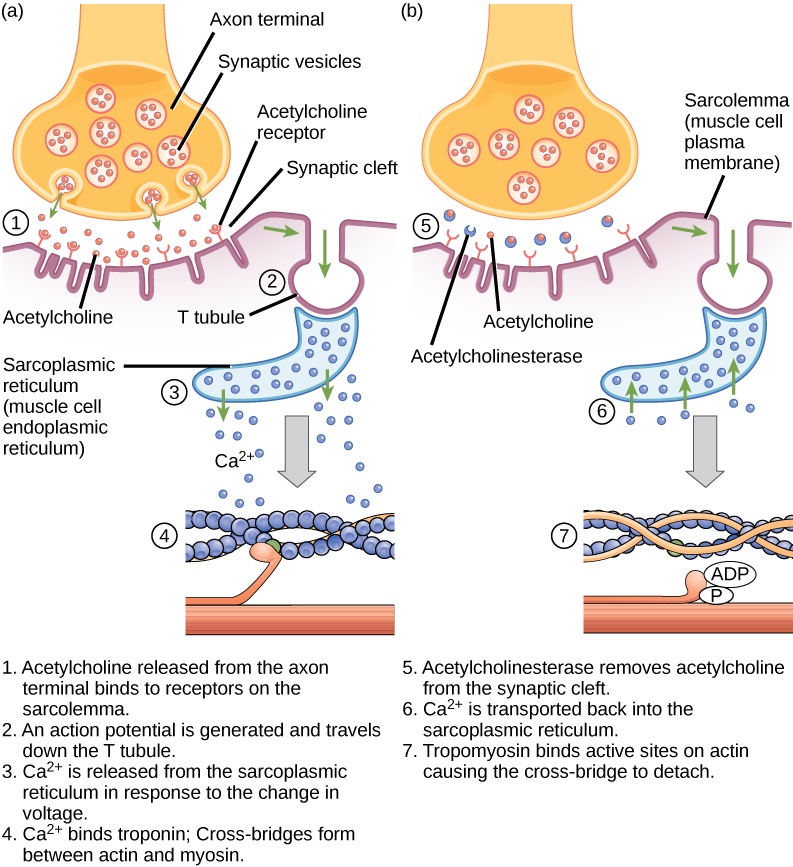
Effigy i. This diagram shows excitation-wrinkle coupling in a skeletal muscle contraction. The sarcoplasmic reticulum is a specialized endoplasmic reticulum found in muscle cells.
After depolarization, the membrane returns to its resting state. This is called repolarization, during which voltage-gated sodium channels close. Potassium channels continue at 90% conductance. Because the plasma membrane sodium–potassium ATPase always transports ions, the resting land (negatively charged inside relative to the outside) is restored. The menstruum immediately following the manual of an impulse in a nerve or muscle, in which a neuron or musculus cell regains its ability to transmit another impulse, is chosen the refractory period. During the refractory period, the membrane cannot generate some other action potential. The refractory period allows the voltage-sensitive ion channels to return to their resting configurations. The sodium potassium ATPase continually moves Na+ back out of the cell and 1000+ dorsum into the jail cell, and the K+ leaks out leaving negative charge backside. Very quickly, the membrane repolarizes, then that information technology can over again be depolarized.
Practice Question
The deadly nerve gas Sarin irreversibly inhibits acetycholinesterase. What upshot would Sarin have on muscle contraction?
Show Answer
In the presence of Sarin, acetycholine is non removed from the synapse, resulting in continuous stimulation of the musculus plasma membrane. At commencement, muscle activity is intense and uncontrolled, but the ion gradients dissipate, so electrical signals in the T-tubules are no longer possible. The consequence is paralysis, leading to death by asphyxiation.
Try It
Contribute!
Did you have an idea for improving this content? We'd beloved your input.
Improve this pageLearn More
Source: https://courses.lumenlearning.com/wm-biology2/chapter/neural-stimulation-of-muscle-contraction/
0 Response to "what stimulates a skeletal muscle cell to contract"
Post a Comment